
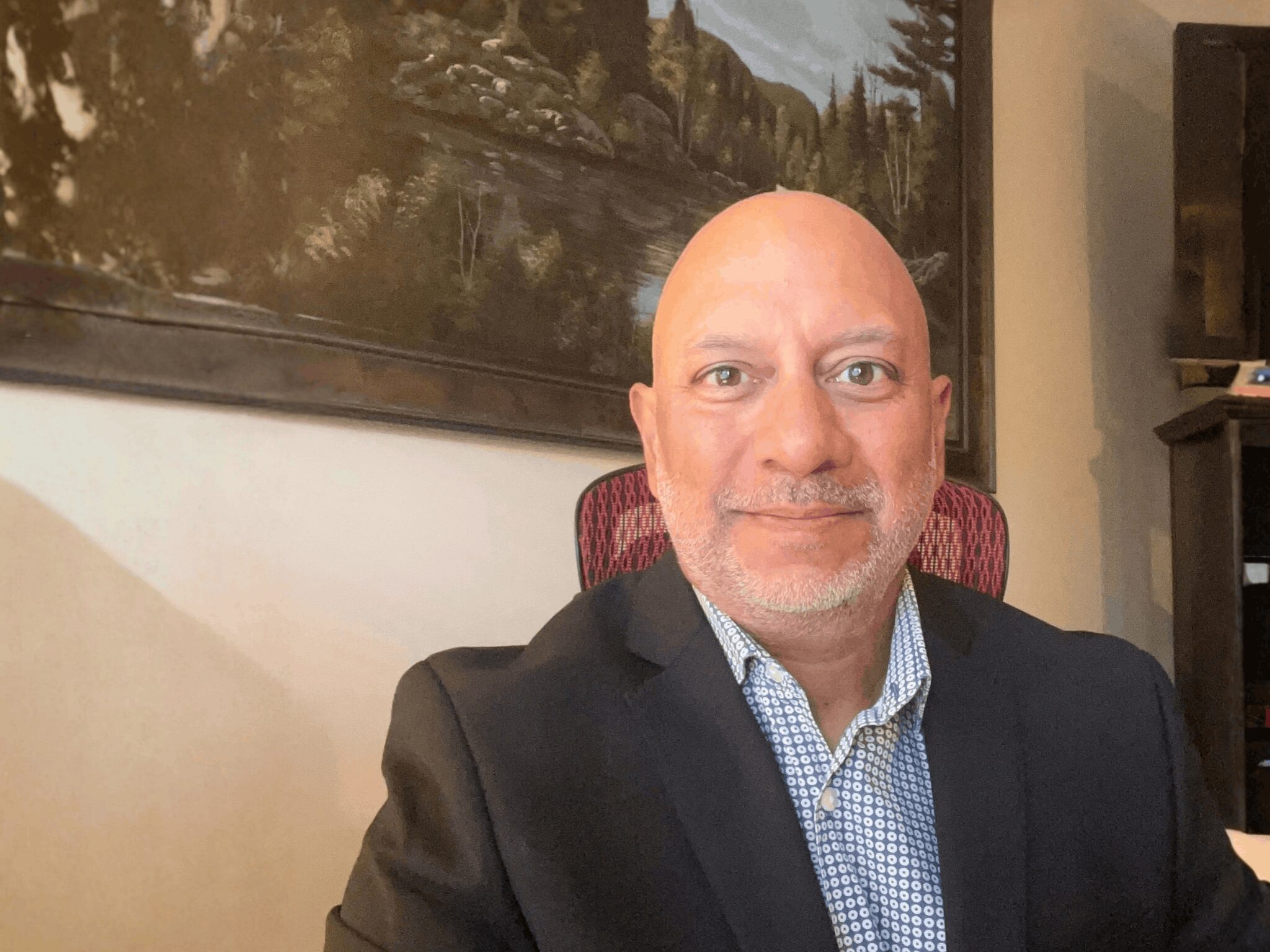
“RONIN” refers to a samurai without a master. While traditionally considered a mark of dishonour, the term can also reflect independence. A RONIN answers to himself and no other person.
Anand Daté is the Founder and President of RONIN Group, an IT staffing agency, a Director at Resonaite.ai, and the Founder of the Men With Heart Charitable Foundation, which provides programming focused on improving men’s mental and physical health.
A 1996 Brock University Business Administration graduate with a major in Human Resource Management, Anand began his career in professional recruitment in Toronto. After navigating the challenges of the 2001–2003 “Dot-Bomb” era, he rebuilt his career and grew RONIN Group, which he incorporated in 2001, into a sought-after private recruitment consulting firm serving some of Canada’s leading organizations.
Anand is also deeply involved in his community, having held leadership and volunteer roles with the Stouffville Public Library, Stouffville Food Bank, Federation of Ontario Public Libraries and other local organizations. He was also a candidate for Mayor of Stouffville in 2018 and 2022.
A fifth-degree black belt and Sensei in Goju Ryu Karate, Anand began his karate training at Brock University in 1992 and served as President of the Brock University Karate Club in 1993.
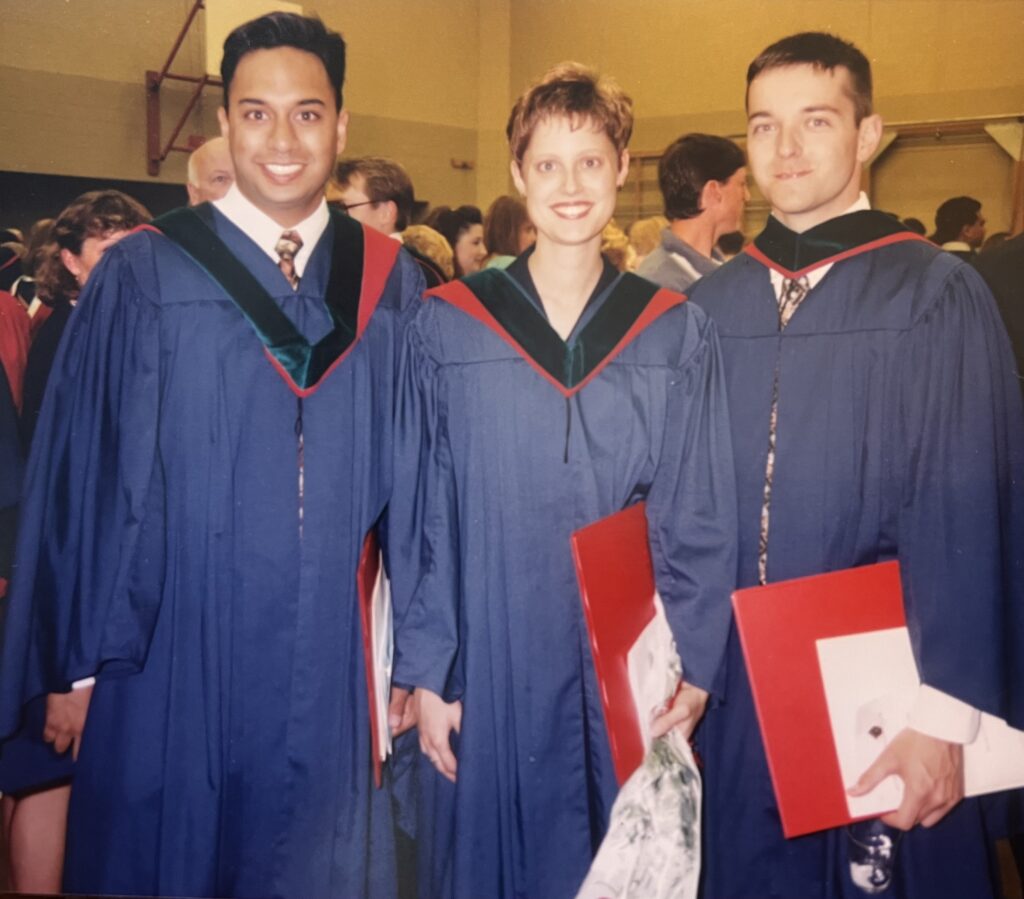
Anand Daté, Susanne Terpstra, and Brent Peters at their convocation, Brock University, 1996.
What led you to choose Brock and the Goodman School of Business?
In high school, university recruiters would come to our school and pitch their programs. I knew I wanted to go into business, and at the time, I associated two universities with strong business programs: Western and Laurier. I didn’t realize Brock had such a strong program until I attended the recruiter presentation.
The people who spoke with us were impressive; many things drew me in. I was accepted to all three schools I applied to, and I chose Brock.
Brock had a strong seminar- and case-study-style learning approach. As a teenager, I didn’t fully understand how important that decision would become, but looking back, it ended up being one of the things that prepared me most for the career that followed.
Brock was the right school, the right environment, the right professors, and the right people at the right time for me.
Are there any fond memories, fun stories, or anecdotes of your time at Brock that stand out?
The professors at Brock were fantastic. They were approachable and easy to reach, not just to ask about the class or your marks, but also to bounce ideas off of. There was a real openness to students wanting to do something beyond the classroom.
For me, that meant creating the Brock HR Club. Professor Broderick also had an initiative called the Brock Business Ambassadors, where I took on a leadership role.
We had a small budget, and I even ended up with an office next to the professors and my own telephone. That was a big deal at the time because almost nobody had a cell phone.
Students were truly supported in pursuing an idea. It was very much, “You have an idea? Okay, let’s hear what the idea is, and let’s find a way to do it.”
That mindset became incredibly important to me.
I was also very involved in residence life. I lived in Village Residence and was named Residence Activity Committee Member of the Year. I had a truck at the time, so if something needed to be moved for an event or activity, it usually ended up in the back of my truck.
Those opportunities were fun, but they also taught me that if you put your hand up, bring forward an idea, and are willing to do the work, people will give you opportunities to make things happen.
Are there any moments from your time at Brock that stand out as formative experiences?
The seminar-style learning and group work we did, particularly in my upper years, were incredibly formative.
We learnt quickly that we needed teams with complementary skills. Someone had the ideas, someone was good with the numbers, someone could pull everything together, and someone was comfortable presenting.
The projects could be intense. There were late nights, Tim Hortons runs to keep everyone awake, and computers physically being moved from one house to another because nobody had a laptop. We could spend weeks or months on a project without knowing whether we were on the right track until we had to stand up and present it.
It was incredibly similar to the real world: you don’t always know the right answer, and you have to figure out how to work with people who bring different strengths to the table.
Those experiences also created relationships that lasted well beyond university. Many of the people I went to school with are still my friends 30 years later.
One woman who had been in my group at Brock reconnected with me years later. I asked her to work for me part-time. Part-time turned into full-time, and she spent 14 years with my company, essentially becoming my second-in-command.
I already knew what kind of person I was getting because we had been in the trenches together years earlier, eating Timbits and trying to get a report finished for the next day.
You don’t build much stronger bonds than that.
How did your Goodman education prepare you for the career path you’ve taken?
When I graduated and started working in downtown Toronto, I was surprised by how familiar some of it felt.
Suddenly, I was thinking, “I’ve got to work with these people. I’ve got to figure out a way to do it.” That was exactly what we had already been practicing through those group projects.
Goodman also taught me how to identify my own strengths and weaknesses and understand the environment around me. Even something as fundamental as a SWOT analysis still works. It has been 30 years, and I think about those principles all the time.
Eventually, all of that became particularly important when I made the difficult decision to walk away from a large consulting firm and start my own company.
Once I did that, suddenly I was every role.
I was accounting. I was finance. I was sales. I was operations. I was the custodian. It was all on me.
Everything I had learned—from compensation and benefits administration and HR to psychology, macroeconomics and microeconomics—came into play very quickly. Decisions we had once made as part of a case study were now real decisions. Where do I spend this money? Should I spend it at all? Should I lease? Should I buy? Who do I hire?
That business foundation meant I could understand and make many of those decisions myself, then bring great people on board and compensate them well to help grow the business.
I really do look back at Brock and credit the school for helping give me that foundation.
Are there any moments in your career where you felt underestimated? How did you become undeniable?
I have been working as a recruiter for over 30 years.
Around the early 2000s, recruitment became very challenging. Some of the most senior people I knew left established firms and started their own companies.
Many of my colleagues found the transition challenging and eventually returned to the agency world.
I looked at that and thought, “If they couldn’t do it, why would I even try?”
But eventually it dawned on me that I had already done things people hadn’t necessarily thought of before. Brock had been a huge part of that. I had proposed ideas and been given opportunities to pursue them. I had learned how to work through something when there wasn’t an obvious answer.
So I did it.
I’ve owned my own company since 2001.
My experience at Brock gave me the courage not to assume that because somebody else tried something and it didn’t work, it meant I shouldn’t try it too.
There were absolutely moments of self-doubt along the way.
There’s a phrase from Formula One that has stuck with me: “Remember who you are.”
Sometimes the world gets you down, and you have to stop, look back at what you’ve already done, and remind yourself that you’re still that person. You can figure this out too.
For me, success has been much less about one magical breakthrough and more about discipline over time. Make good decisions. Treat people well. Work honestly. Work intelligently.
Do that over and over again, and eventually you look back and realize you have accomplished quite a lot.
And get up at least as many times as you fall down.
What milestones or achievements best represent your career journey or impact since graduating?
Starting my own company is certainly one of them. Taking the chance to leave and build something myself fundamentally changed the course of my career.
However, a lot of the milestones I’m proudest of also involve staying connected to Brock.
I have continued working with the faculty and have come back to speak with students. I stayed connected with other alumni, and together we created a golf tournament that ran for eight years.
Over that time, we raised approximately $350,000 for scholarships for Brock business students.
Those relationships mattered. People I knew through Brock went on to become directors, vice-presidents, and C-suite leaders at major organizations. We grew together, and we continued finding ways to support one another and the students coming behind us.
That is something I think we need to keep building.
As a recruiter, I also have the ability to influence whose résumé gets seen.
When I see Brock on a résumé, I know what that person went through. I understand the education and the kinds of experiences that helped shape them. That doesn’t mean they automatically get the job, but I can say, “Let’s have a conversation with this person.”
If those experiences helped make us who we are, there’s a good chance they are helping shape the next generation too.
How do you hope your story inspires the next generation of Brock and Goodman graduates?
For new graduates, I always say: lean on your connections and use all of the skills available to you.
The first opportunity is often the hardest one to get.
If you have great communication skills, use them. If you have presentation skills, use them. If you have great ideas, use them. If you have connections, use those too.
Don’t be ashamed if a family member, professor, classmate or someone else in your network helps you get that first opportunity. Get there, prove yourself, build momentum and eventually you’ll be in a position where you can help somebody else.
Job searching has changed enormously with AI, algorithms and applicant tracking systems. It can be incredibly discouraging to submit résumé after résumé and hear nothing back.
Pay attention to how an organization describes what it needs. If a job posting uses particular terminology for something you already know how to do, use that terminology on your résumé rather than an obscure synonym. Make it easy for both the technology and the person reviewing the application to understand that your experience is relevant.
Then, when you get the interview, pay attention again.
Ultimately, employers are trying to answer two major questions: Does this person have the technical capabilities to perform well within the job, and does this person have the interpersonal skills to be successful within our corporate team environment?
You need to demonstrate both.
Sometimes standing out means doing what other people aren’t doing anymore. Pick up the phone. Go to events. Meet people. Put yourself in the environments where the people you want to work with actually spend time.
Watch and listen at least twice as much as you talk. Be curious. Pay attention.
One of the more controversial things I sometimes tell people when they ask about my keys to success is, “Laziness has gotten me everywhere.”
What I mean is that if I’m going to do something, I want to do it properly the first time so I don’t have to keep revisiting it. Get it done well, learn from it, and move on to the next thing.
Why is supporting the Goodman Legacy important to you, and what does legacy mean in the context of your journey?
To me, legacy means my two young sons knowing that their dad worked hard and helped people along the way. Supporting the Goodman Legacy is a really good vehicle to help make that happen.
Brock is much more than somewhere I went to get a degree. It is part of who I am, and that connection has stayed with me for 30 years.
I still have my old Brock jacket. It is more than 30 years old now. It’s getting yellow, it’s falling apart, and the elastic barely works anymore, but I love that jacket. I wore it proudly at Brock and continued wearing it afterward because I was proud of where I came from.
Now that I have two young sons of my own, I sometimes wonder what their university experience will look like. I hope they have the opportunity to build the kinds of relationships and experience the sense of community I was fortunate enough to have at Brock.
There are incredible people in the Goodman community who are innovative, hardworking and bring very different skills to the table. Put those people together, and you can solve problems, create opportunities and make things better for the graduates coming behind you.
I believe it is important to contribute in whatever capacity I can, whether that means giving my time, helping someone find an opportunity, supporting students financially or simply showing up.
Strong alumni communities don’t simply appear.
People build them.
We’re building this.
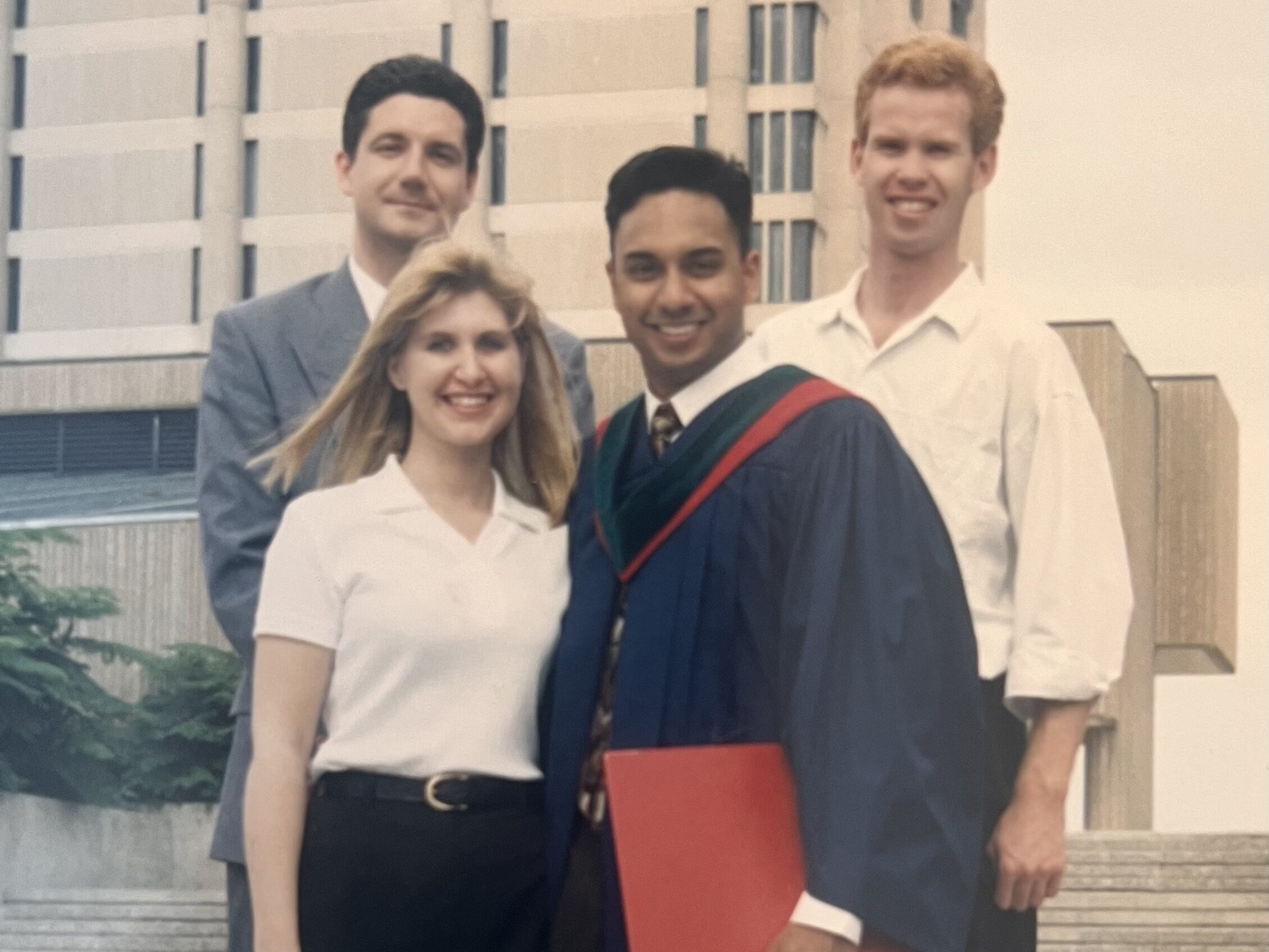
Front, left to right: Christina Scott and Anand Daté; back: Dan Russell and Brian “Opie” Jonkman. Brock University, 1996.




Stay Connected
Brock University
St. Catharine’s Campus
1812 Sir Isaac Brock Way
St. Catharine’s, ON
L2S 3A1, Canada
Privacy
| Terms & Conditions
Copyright © 2026 Goodman Legacy