

David McQuilkin (BBA 1985) is the Dealer Principal and President of Milton Ford Lincoln and Milton Nissan Inc., a long-standing automotive dealership serving the Milton community and the surrounding region. In this role, he leads overall business strategy, operations, and performance for a dealership that has been a key part of the local automotive market since 1967.
With extensive experience in the automotive retail sector, David has built his career around dealership leadership, operational growth, and customer-focused service. Prior to his current position, he served as Vice-President and Dealer Principal at Whiteoak Ford Lincoln, where he developed a strong track record in dealership management and performance optimization.
McQuilkin’s leadership approach emphasizes customer experience, team development, and measurable growth. After acquiring the Milton dealership (formerly Gallinger Ford Lincoln), he led a significant transformation of the business, driving substantial increases in vehicle sales, service performance, customer satisfaction and overall market share, even during challenging industry conditions.
His management philosophy is rooted in long-term relationships and operational excellence, centred around three pillars: Integrity, Family and Community. He is known for prioritizing customer satisfaction, empowering key team members, and fostering a culture built on accountability and results. Under his leadership, the dealership has achieved strong performance metrics across sales, parts, and service operations, positioning it as a competitive force within the Canadian Ford and Lincoln retail network.
Beyond dealership operations, McQuilkin has also contributed to the broader automotive industry through governance and representation roles, including serving as a dealer representative within Ontario’s motor vehicle regulatory framework. He was also a CADA Laurette finalist in 2024 for Business Innovation.
During his personal time, he enjoys cycling, golfing, skiing, snowboarding and travelling.
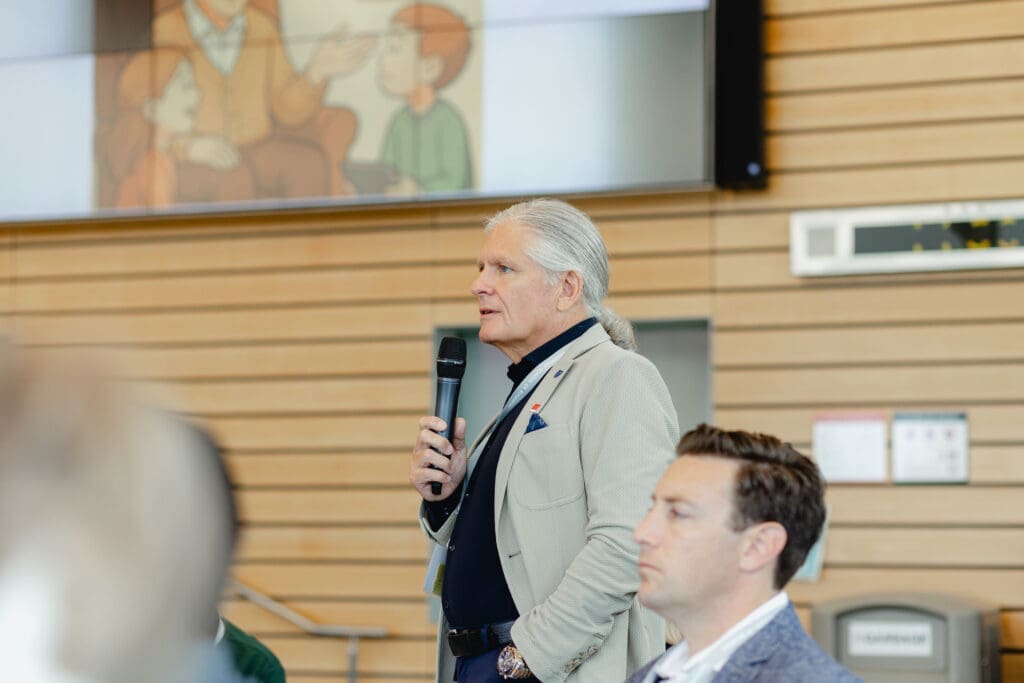
What led you to choose Brock University and the Goodman School of Business?
My parents, Jim and Joan, were very, very loving, but no one in our family had ever gone to university, so I didn’t receive a lot of educational guidance.
After grade 13, I knew I wanted to be an entrepreneur, I knew I wanted to own my own business, and I knew I needed to get some kind of skill set to get there.
That August, I remember watching a bunch of my buddies packing up and heading off to school. I thought, I’ve got to do something here.
So I grabbed my high school transcript, got in my 1968 Chevy Impala, and drove down to St. Catharines. I walked into the Brock University registration office and asked if I could apply for that fall.
The administrator looked at my transcript and said, “Oh, you done good.”
I asked,
Could get into school? “Yes.”
Could I get into business? “Yes”.
Was there room in residence? “Yes”.
Well, what do I do now? She said, “Show up in two weeks.”
That’s it. I went back to my summer job and showed up at Brock two weeks later, with no clue what to expect.
In the second year, I had to declare my specialty. Around that time, my dad’s company was on the verge of bankruptcy during the ‘82 recession.
My dad came home from one of his banker meetings. He looked at me and said, “Son, learn accounting. Those damn bankers talk down to you, and if you don’t know what you’re talking about, they make you feel stupid. Don’t let them do that.”
So I chose accounting.
An accountant with a personality: I figured I’d do great.
Are there any moments from your time at Brock that stand out as formative experiences?
What I learned early was that university isn’t hard, it’s just a massive amount of work. If you stay on top of it, you’ll get through.
I tell kids who work for me now and who are in school, that the only word they need to know is “no.”
No, I can’t go out until I finish my work. Self-discipline is everything.
What I didn’t appreciate at the time was the breadth of what Brock was teaching us. The business case study approach and the electives they pushed you into.
My favourite course was supposed to be a bird course: French Culture and Civilization. I’ve never been to France. But I absolutely loved it, and I still draw on it today to talk about architecture, the Renaissance, and European history.
You get this breadth of knowledge that you don’t value in the moment, but you really come to appreciate later.
While at Brock, I joined the fencing team – which I still get teased for – I ranked in the top 10 in Ontario and was asked to train with an Olympic coach, and sometimes I wonder what would have happened if I’d kept it up.
But that’s the thing about university, it’s a time when you can try anything. I was on the track team, played football and hockey, and was active in the school parliament.
My advice is to take every opportunity to try something you’d never do anywhere else.
Are there moments in your career when you felt underestimated? How did you become undeniable?
Failing my Charter Accountancy exams still bothers me today, and that was over 40 years ago. More than 50% of students failed at the time, so I wasn’t alone, but there’s something about that word, “fail,” that sticks with you.
But I used it as fuel. I took the skills I had built and leveraged them into something else, rather than grinding away at something that wasn’t working.
Henry Ford went bankrupt multiple times before the Model T took off. His line has always stayed with me: “whether you think you can or you think you can’t, you’re right.”
Don’t let failures push you back; use them as motivation.
After gaining experience at a chartered accountancy firm, I moved into commercial lending at Scotiabank through its Commercial Officer Development program, which typically hired only MBAs.
I didn’t have my MBA. I didn’t have my CA.
But I absolutely excelled. It felt natural, like surfing, when the water is doing the work, and you’re just riding it.
I was promoted rapidly. At one point, I had a staff of 95 reporting to me in my mid-twenties.
The case study approach from Brock had taught me how to deconstruct a problem, separate the symptoms from the root cause, and focus on what was actually driving the issue.
A lot of people focus on red herrings. The critical learning approach was invaluable, especially later at a dealership, where you’re constantly dealing with emotional, non-rational situations. You have to peel back the layers and ask: what is actually going on here?
What ultimately pushed me out of banking was realizing that in a large corporation, there’s always going to be someone above you holding you back.
Then a car dealer, who had been hounding me for years to come work for him, walked in on the right day, and I told him: if I do a good job for you, in five years you recommend me to Ford.
And almost to the day, five years later, I bought the business.
What experiences, courses, or people at Brock had the greatest influence on your development?
The case study approach was, without question, the most formative. I still quote some of those case studies today.
The education was exceptional.
What I also learned at Brock, strategically, was to identify your weaknesses and make a real effort to improve them, not just coast on your strengths.
Marketing came naturally to me. Personnel came naturally. But accounting was my weakest subject, so that’s what I chose to major in.
I wanted to be a better leader, a better businessman. I firmly believe accounting gives you the bedrock foundation to succeed in any business.
Get in, get your experience, and then go sell something. Between those two skills, you can achieve almost anything.
The other thing that underpins everything for me is integrity. I use the line: “A shortcut is a pay cut.”
On the back of our Milton Ford Lincoln business cards, we list our three pillars: integrity, family, and community. Those aren’t just words.
We want to be the organization with the highest integrity, that looks after its customers’ and employees’ families, and gives the most back to the community it operates in.
That commitment has had tremendous payback over the course of my career.
What are the career milestones that best represent your journey?
Buying my first business at 34 was the defining milestone.
You work hard, you set a goal, you achieve it, and that business runs successfully for over 20 years. Then selling it.
Then, retiring, which, by the way, was a disaster.
If you don’t have a real hobby, retirement is horrible. I tried it, and it lasted about five minutes in Florida before I was back at it.
So in 2019, I bought the Milton Ford Lincoln dealership.
Automotive News actually ran a story on it because individuals don’t buy dealerships anymore; it’s all groups of investors. They asked me what was going on. My answer was simple, “I was bored.”
Milton Ford Lincoln is now an award-winning store and fourth in Canada for Ford sales.
Along the way, I’ve funded other businesses, become a partner in others, acquired a second dealership, and started exporting cars to the United States. Last year, I bought a 48,000-square-foot industrial building next to the dealership. So, now I’m a landlord too.
But honestly, the milestone that means the most is not a transaction.
It’s the people.
We are responsible for the incomes of 60 families.
You go home and think about that, and that’s the real reward. You’re affecting people’s lives in a genuinely positive way.
Why is supporting the Goodman Legacy important to you, and what does legacy mean in the context of your journey?
I strongly believe corporations have a social responsibility to donate back to the communities where they generate their wealth. The same principle applies here.
It’s not lost on me how differently my life could have turned out if I hadn’t driven down to St. Catharines that day, or if Brock hadn’t let me in.
There’s a shared undercurrent among all of us on the council. A feeling of not having received the recognition we knew the program deserved after graduating.
We all have the same thought: wait a second, our graduates should be getting the same respect as any top school in Canada. That’s part of the motivation.
Brock is a tier one business school, and it’s time the world knew it.
Major universities have endowment funds worth hundreds of millions of dollars. Why not us?
What’s really cool about the Goodman Legacy Fund is that it is controlled by the alumni.
We’re not aware of any other university program structured that way. You’re not writing a cheque into a black hole.
Goodman Legacy is full transparency; you can be part of the investment committee, part of the disbursements, whatever level of involvement you want.
We’ve already seen funds go toward feeding students. What kind of world are we in where someone is in university and doesn’t have food security?
A lot of needs will come to the surface once word gets out that there’s a fund here specifically to support Goodman students.
We’re here to fill the cracks where there isn’t funding, and to elevate the areas that need it. Not to replace the university budget, but to augment it.
An idea needed to germinate, and a few people needed to find each other. And now here we are. It’s long overdue, and I’m proud to be part of getting it off the ground.
It’s neat to be one of the founders. The goal is to keep opening the tent, bring in more founders, and build this into something that will continue to grow 20, 30, or 100 years from now.
That’s what legacy means.




Stay Connected
Brock University
St. Catharine’s Campus
1812 Sir Isaac Brock Way
St. Catharine’s, ON
L2S 3A1, Canada
Privacy
| Terms & Conditions
Copyright © 2026 Goodman Legacy