

Mike Pilato (BAcc 1998) is President and CEO of Jamieson Wellness, a growing global health and wellness company with a presence in over 45 countries and regions.
Since joining the company in 2018, Mike has been instrumental in positioning Jamieson Wellness for global growth. He has led the organization through several transformative initiatives, including the successful acquisition of US-based Nutrawise/youtheory in 2022, Jamieson Wellness’ largest acquisition to-date. He also led the ownership transition of Jamieson’s business in China, positioning the company for success in the fastest growing VMS market in the world.
Prior to joining Jamieson Wellness, Mike spent over a decade with The Clorox Company in progressively senior Finance, Brand Management, and Sales positions, including General Manager and President, Canada, where he led unprecedented growth across multiple categories. He previously held cross-functional roles at Playtex Products and Kraft Foods.
Mike currently serves on the Board of Directors at Melanoma Canada and previously served as Director at the Food, Health and Consumer Products Association of Canada (FHCP) from 2015 to 2023, including terms as Vice-Chair and Treasurer. He holds a Bachelor of Accounting degree from Brock University and a CPA designation. He also serves as a member of the Goodman School of Business Legacy Council.
What led you to choose Brock and the Goodman School of Business?
My story is interesting. Brock was not my first choice; it was actually my third.
I knew I wanted to get an accounting degree, not because I wanted to be an accountant, but
because my dad taught me that accounting is the backbone of business.
He said, “Get your degree in accounting, get your designation, and when you move into marketing or sales or wherever your strengths take you, you’ll have a leg up on everyone else because you understand the numbers.” That stayed with me.
What changed my path was a man named EJ Freeland. He was a successful businessman from Fort Erie, where I grew up in the Niagara region, and he put his money where his mouth was.
He created scholarships specifically for bright students in the Niagara region to support their education at Brock. He believed in investing to keep talent in Niagara.
I was nominated for the scholarship, I competed for it, and I won. The scholarship covered my tuition, my books, essentially everything except room and board as I chose to live on campus to have the full university experience.
Brock also had one of the province’s top Bachelor of Accounting programs at the time and still does. Between the scholarship and the program, I couldn’t walk away from the opportunity, so I accepted.
There’s one more thing I should add: Funny enough, I competed for that scholarship against my wife. We didn’t start dating until years later, but we laugh about it today.
She ended up going to McMaster and EJ even found a way to support her education, too. That was the kind of person he was, and honestly, watching what he did for both of us is a big part of why I work to give back now.
He showed me what it looks like to take your success and use it to support and inspire the next generation of business leaders. He gave back in a big way, inspiring me to choose Brock – a decision I am proud of.
Are there any moments from your time at Brock that stand out as formative experiences?
It’s not one moment. What stands out is the overall experience at Brock.
All Ontario business schools have a good reputation, but they don’t all have the same profile as the larger and more established schools. Brock is both a smaller school and a rather new school, recently celebrating its 60-year anniversary. Despite its size, Brock and the Goodman School of Business helped me understand the power of community. I never felt like I was in competition with my peers, but rather in sync with them. We bonded with each other and worked to win together instead of individually.
This experience has contributed to my belief that success in business is driven by two key factors:
First, you must deliver consistent results. To use a baseball analogy, you can’t step up to the plate and hit one home run but then strike out 25 times in a row and be successful. The best players consistently hit a single or double every game throughout their entire career.
The second is that business is a team sport, and the most successful individuals are the best team players. Growing up in a small town and attending Brock taught me the importance of having a positive impact on the people around you. The same principle applies to business; to deliver consistent results, you must build a supportive environment where you help your team be its best. You want your team members to feel like you would run through a brick wall for them, because you would want them to run through a brick wall for you. And really, subconsciously, I learned that at Brock.
Even now, when I go to campus, I can feel that with the students. They’re not competing but rather working with each other to succeed.
Are there any fond memories, fun stories, or anecdotes from your time at Brock that you’d like to share?
I have plenty that won’t make it into this interview, but what I will say is that two great friendships in my life started at Brock.
The first day I walked into residence, I met a guy named Steve. I didn’t know him at all, but he was my new roommate. We ended up living together all four years, and we’re still friends to this day.
The second friendship is with a guy named Rick. I met him in my first-year accounting class.
I’ll be honest, I wasn’t putting my all into my first two years, but I prioritized my studies in years 3 and 4.
I walked in one morning in rough shape after a night out – I probably hadn’t slept. He took one look at me, saw I was in rough shape, and asked if I had done the assignment. Unfortunately, I did not.
He said, “Sit down, man. We’ve got fifteen minutes. I have got to help you.”
He just had my back, completely unprompted. That was it. We were great friends from that point on and virtually inseparable for the remainder of our university years.
My life has come full circle in the best ways through Brock, and those friendships are one of the best things Brock gave me. I still have great memories that vividly appear when I walk the halls today.
What experiences, courses, people, or programs at Brock had the greatest influence on your development?
This one is very clear for me, Professor Brown.
I knew I wanted to be an accountant, but I didn’t actually want to be an accountant. The idea of
working at an accounting firm performing auditing and tax scared me. It didn’t feel right and didn’t match my strengths.
There was a management accounting course that cracked something open for me and showed me there was a whole corporate finance world inside companies that I hadn’t considered. Professor Brown was the one teaching it.
I started going to his office hours, not just for help, but to talk.
In my fourth year, I went to an office hour and told him, “I don’t think I can do the Chartered Accountancy (CA) route. I don’t know what to do.”
And he said, “Well, why would you? Go get your Chartered Management Accountancy (CMA).”
I didn’t even really know what the CMA was at the time. He walked me through it. He told me it would get me into the corporate side of finance, where I could eventually move into marketing, sales, supply chain – wherever my strengths took me.
He said, “If I were you, I would not pursue your CA. It’s not following your heart, and it’s not following your strengths.” Everyone else was pointing toward the CA. He was the first one to say, “Time out.”
I use that lesson constantly when I mentor young people now. Everyone says follow your
passion. I push back on that. If I had followed my passion, I would still be trying to be a 5’6 professional athlete.
What Professor Brown actually taught me was to follow your strengths. Find what you’re genuinely good at, because if you find a career path you’re good at, you’ll succeed at it. If you succeed, you’ll find happiness. If you’re happy, you’ll work harder. It’s a flywheel that gives back for years when you find that sweet spot between your strengths and a career.
Are there any moments in your career where you felt underestimated? How did you become undeniable?
I graduated in 1998, and by 2001, I was working at Kraft Foods, the largest food company in Canada at the time, with +$3 billion in sales, and a global Fortune 500 powerhouse.
On my very first day, I was asked to come to a meeting. I walked into a room full of people, and it was immediately obvious: everyone there was from high profile, established business schools. I’m the only one from Brock, and I’m pretty sure half the room didn’t know where Brock even was.
That was a moment in my life where I genuinely thought: how did I get to this table, and do I belong here?
The meeting was run by a senior VP who is still a good friend twenty-five years later. He went around the room asking for opinions. He got to me, the new guy, and said, “You’re new. What do you think?”
I had two options.
I could play it safe, say what everyone else was saying, try to blend in.
Or I could just be myself and say exactly what I thought.
I went with the second option.
I have no idea if I actually knew what I was talking about, but I gave my honest read on it. As we were walking out, Dan came up to me and said, “Hey, that was a great answer. You’re going to do great here.” And he walked away.
Two things hit me at that moment. One, I belonged at that table. Two, the small things senior people say to junior people matter more than they know.
I make a point of that now by stopping to thank or talk to junior people in hallways, elevators, and meetings because I remember exactly what that felt like.
I also tell my kids this, and I’ll say it here: a good education at a good school can help you get your first real career opportunity. But once you get in the door, your degree stops mattering. What matters is whether you work hard, drive consistent results, and have a positive impact on the people around you. That’s entirely up to you.
What motivated you to get involved with the Goodman Legacy Council?
I grew up in Niagara. I don’t live there anymore, but I miss it, and I was looking for ways to give back to the area that shaped me and my life.
Brock University felt like the right place to do that and being a founding member of the Goodman Legacy Council felt like a great start to help raise the profile and reputation of the school.
I also co-created an informal speaker series at Brock, Coffee and Conversations, with Susan LeBlanc.
The traditional model was bring in a business leader, put them in a lecture hall, everyone gets in their business attire, and the speaker gives a formal address. But… few showed up.
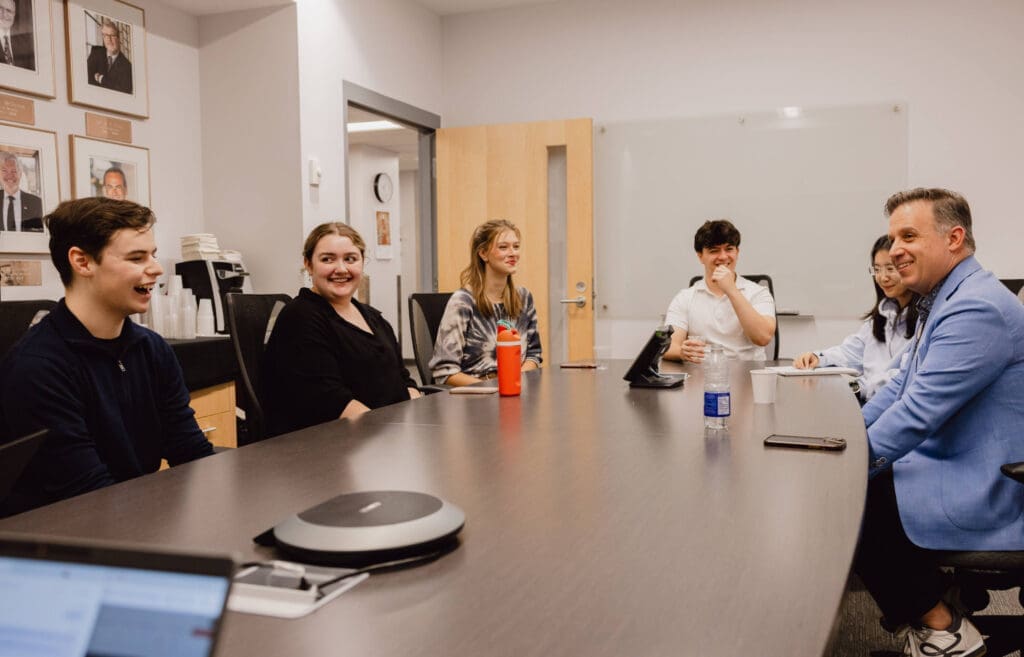
I said, “Let’s flip it.” and come to their space. Sit on couches or around a table, eight to ten students, coffee, no agenda. I wear jeans and running shoes. I open the floor and let them ask anything they want. It’s high energy with topics about careers, leadership, business, and life. We are there on their terms, in their space, and the demand for spots has been high.
It was transformational from the first session, and I likely get more energy from those students than they get from me.
That’s what I’m here for, not to cut a cheque, but to build the story and help Goodman and Brock go from underestimated to undeniable. We no longer should feel like the underdog, but rather that we belong at every business table there is. Let’s show the students the strength they have and the possibilities ahead of them – and that is what matters the most to me in this endeavour.
How do you hope your story inspires the next generation of Brock and Goodman graduates?
I want students at Brock to know that it doesn’t matter that they didn’t go to one of the high-profile schools everyone tries to recruit from. They have just as strong an education to do anything they want in life.
If a small-town kid from Fort Erie and Brock can become the CEO of a 104-year-old Canadian public company driving growth globally, then they all can. The opportunity is there for those willing to work hard enough to seize it.
The further along I’ve gotten in my career, the more I feel like I have to use my story to build the reputation of Goodman. If it helps even one student or alumni believe they belong at any table, it’s worth it.
Brock is a great story hiding in its own shadow. It is now 60 years old with Goodman having 20,000 graduates.
We have a track record, real success stories, and an administration that finally wants to get out of that shadow. Now is the moment to change this. The conditions are right, and the people are in the room. Let’s go.





Stay Connected
Brock University
St. Catharine’s Campus
1812 Sir Isaac Brock Way
St. Catharine’s, ON
L2S 3A1, Canada
Privacy
| Terms & Conditions
Copyright © 2026 Goodman Legacy