

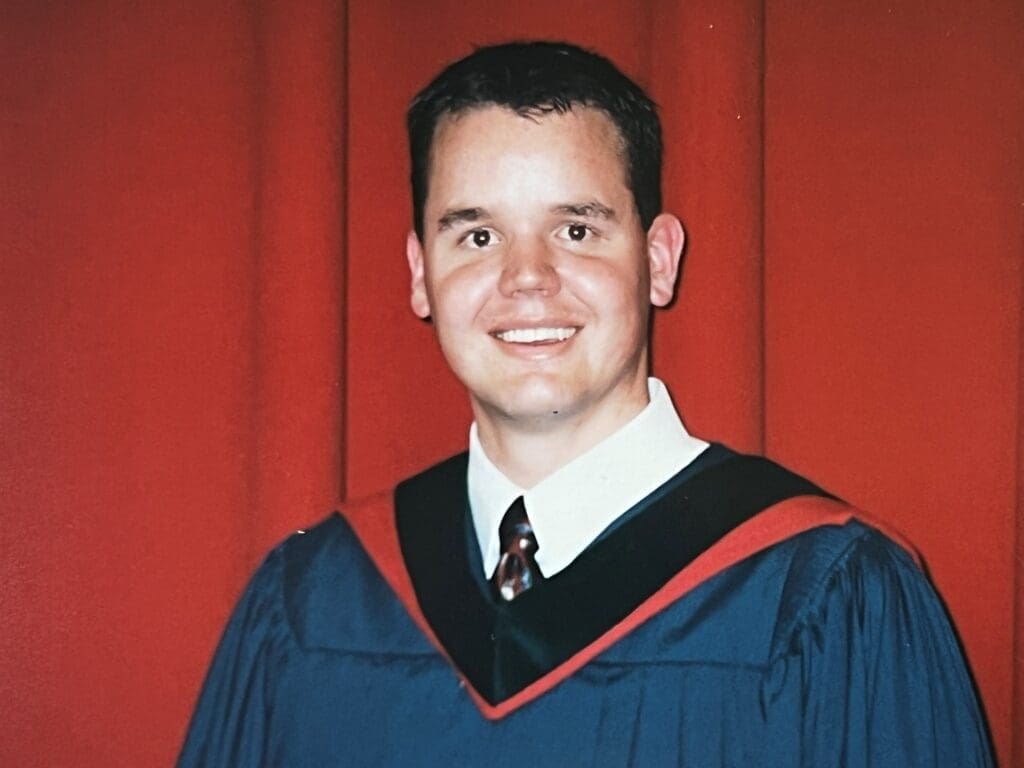
Jon Faber (BBA 2002) has been President, Chief Executive Officer and a Director of Pason Systems Inc. in Calgary, Alberta since 2020. In this role, he holds overall management responsibility of the company and helps shape the growth agenda and future of Pason. Jon originally joined Pason as Chief Financial Officer in March 2014.
Jon previously held roles in investment banking with National Bank Financial and Wellington West Capital Markets and worked in disability and critical illness insurance marketing with Great-West Life.
Jon received a Bachelor of Business Administration in Marketing from Brock University and a Master of Business Administration from Purdue University and holds the Chartered Financial Analyst, Chartered Business Valuator, and Chartered Professional Accountant designations. Jon has also completed the Advanced Management Program at the Wharton School of the University of Pennsylvania.
What led you to choose Brock and the Goodman School of Business?
I originally went to Brock for their accounting program.
At the time, schools were ranked based on their performance on the Uniform Final Exam for Chartered Accountants. If I recall correctly, Brock was ranked number two in the province. It also had a co-op accounting program at a time when co-op was a very new concept.
As it was a Bachelor of Accounting, you could get through the entire program in four years, a little longer if you were doing co-op, which was faster than almost anywhere else, so I was sold.
Of course, the irony is that by the time I got through the whole program, I had removed myself from the co-op program because I loved being on campus. I graduated in marketing, not accounting, and I did it in five years instead of four.
So all of the reasons I went there ended up being completely irrelevant by the time I was done, but that was why I originally chose Brock.
Are there any moments from your time at Brock that stand out as formative experiences?
The biggest thing for me was the amount of presentation and communication work we did.
Most of what I do today has nothing to do with anything I learned in the classroom in terms of textbook content. It’s much more around: how do you get people to work together toward collective outcomes?
Communication is obviously a very big thing. How do you put together a reasonably persuasive argument for the people around you? Why are you doing what you are doing? Most of that isn’t in the textbook – it’s the soft skills, the interpersonal dynamics, and the communications.
When I think about what stands out as most relevant to what I do today, it’s far more in the area of communication than in any specific class or content.
Then there’s the piano story.
I was on the Residence Action Council in a role called the National Communications Coordinator. My role was to speak to residence leaders at other schools across Canada about how they were building residence culture. Our team was invited to the president’s office at Brock to debrief on a conference we had attended.
Somehow, that turned into an invitation to the President’s Christmas party, and someone mentioned I played the piano. By the time most of the people had left, and there were about 10 of us remaining, the president, David Atkinson, said, “Let’s hear about this piano thing.”
That’s how it started; that relationship ended up being one of the more important ones of my career.
The deepest formative experience at Brock had nothing to do with the school itself.
I’m a twin from a small town. I was on the same soccer team, baseball team, same job, everything as my brother. Nobody ever associated me as an individual, always as half of a pair.
When I went to Brock, nobody knew I was a twin. For the first time, I was somewhere, figuring out who I was as an individual.
I had this observation early on that when I did things that made other people feel good, I felt weirdly good about it, and they seemed to like me more than if I made them feel bad to make myself feel better. That was a real turning point.
It had nothing to do with the Goodman School of Business itself and probably everything to do with the situational awareness of somebody who’d never been an individual before.
Are there any moments in your career where you felt underestimated? How did you become undeniable?
I got into investment banking in 2005 with no finance degree, no finance designation, and maybe three finance courses to my name.
I had gone to this school called Brock University that nobody in the finance world had heard of, and then I’d done an MBA through Purdue University in Germany.
When I used to speak at universities, professors would always say, “Never mind what you actually do for a living, talk about how you got here, because you’re weird,” and they weren’t wrong.
I took the wrong program at the wrong school on the wrong continent if you wanted to become an investment banker.
If I had done everything right, I would have gone to a marquee business school, studied finance in Canada, and done an MBA in finance.
I did 100% of everything exactly wrong.
But it occurred to me that I could probably figure things out. If I could convince somebody to think I might be worth taking a shot on, I would figure it out from there.
So I bought a new pair of shoes, put a lot of $20 bills in my pocket, and started buying coffee for people. My approach was to ask people: if you were me, came from this strange background and wanted to do what you’re doing for a living, how would you think about getting there?
I was fortunate enough to meet a gentleman who used to be a Vice Chairman of one of Canada’s largest banks. I met him at his cottage, and he asked me the question: “Everybody wants to be an investment banker. What makes you different?”
Then he said, “You seem to do a lot of stuff at this Brock University place. Do you think anyone there would give you a reference?”
I said I could probably get one from David Atkinson, the president.
He seemed to think that was reasonably important. The problem was that by the time I went to follow up, David had moved from Brock to Carleton.
So now I was calling Carleton University, which had never heard of Jon Faber, saying: “I need to talk to your president if it’s not too much to ask.”
Somehow, for reasons I probably still can’t explain, in my inbox the next day was a letter of recommendation from David Atkinson on Carleton letterhead.
I went back to this gentleman’s cottage to bring him the letter. He looked at it and said, “You mean to tell me that in 24 hours you called Carleton University, who had never heard of you, got through to the president, and he turned around a reference letter?”
He said, “I will introduce you to some people.”
Then I went on my path of $20 coffees, and away we went. Eventually, somebody said, “We’re not really hiring, but we would hire if you were available, because you seem interesting.”
That’s how I got into investment banking.
What milestones or achievements best represent your career journey or impact since graduating?
The traditional milestones are there: getting into investment banking with no logical credentials, the MBA, a couple of designations along the way, being asked to consider a CFO role, and being asked to take a CEO role. Those things felt significant.
At the end of the day, those things don’t actually matter. I’m one person trying to lead a company of about 950 people. It’s not about how much I can get done; it’s about how much I can get out of the other 950 people.
There are 24 hours in a day and seven days in a week, and my brain capacity is limited relative to the capacity of 950 people. So the things I take most pride in are what our people have accomplished and whether I’ve had some role to play in that.
My favourite moment in my career was actually during my time as CFO. We had someone on the team who had just finished her MBA. She was one of my best people. I had lunch with her one day during a downturn in the industry, and I told her I thought she needed to leave.
It was waterworks; she thought she was being fired.
I said, “No, here’s the problem. This company is going to shrink for the next couple of years, and if you want to do something bigger on the back of that MBA, I’m not going to be able to offer it. You need to go somewhere else where you can expand and grow.”
A couple of days later, I walked through her office and asked if she had seen a job posting at another company in town. She said she had, but they had not responded to her. I said, “Well, you know I know the CEO, the CFO, and the hiring manager? I could probably get you a conversation.” So I sent them a note saying that she was great and they should take her from me. I’m sure they thought, “This is weird, I’ve never seen this before.”
Seven years later, I was at my son’s baseball game, and one of the dads came up and said, “You’re the guy. She works for me. Our company still talks about this story.” Recently, I met a lawyer who works with that company. He asked, “Do you know her?” I said, “Yes, she used to work with me.” He said, “I know, I’ve heard the whole story.”
That’s more rewarding than anything I’ve ever accomplished in my life. You set somebody else on a path. That’s far more important.
How do you hope your story inspires the next generation of Brock and Goodman graduates?
I really hope that people have a sense that you can do what you want, regardless of where you came from.
As much as we are working really hard to get people to recognize that Brock is a great school, I don’t think you’re ever going to find a world where people think Brock is somehow the same as going to one of the marquee business schools.
That’s okay.
What I hope people see is that there are many different ways to get to where you want to be. It’s really about understanding who you are, saying yes to opportunities, and recognizing where you can take things on.
The fact that you went to a school that people aren’t as familiar with is not a limiting thing in any way, shape, or form. Very few people have really heard of Brock outside of Niagara, if you’re honest.
You can’t rely on the brand as a default gold-star checkbox. You have to make it on the merits of proving yourself. I actually think that’s an advantage.
I was having this conversation with our board; our company has been built on A players from B shops, not B players from A shops. When we’ve brought people in from blue-chip companies or schools, they have rarely succeeded.
If you look at our executive team, it’s people from lower-tier law firms, lesser-known investment banks, and schools like Brock. It’s people who had to make it on their own merits rather than just relying on their school name.
What motivated you to get involved with the Goodman Legacy Council?
The school gives people capabilities. It creates people who, I think, are more compelling, quite frankly, than schools with a very narrow, similar-looking profile of very high academic achievers.
My grade 11 son is considering schools that are more like Brock, and I think he’ll come out a better-rounded person as a result.
That’s really the inspiration for me getting involved: I believe that at Brock, we produce really great human beings, not just smart business-knowledge people. We probably haven’t done a great job making sure people are aware of that.
The other piece is that the school is under stress, and when budgets shrink, the awareness message is the first thing to fall away. All of a sudden, you’re worried about how to pay the professor teaching today, as opposed to how to keep people aware that Brock is a great choice, and it really is.
Other people are going to have to step in and fill those gaps so that the important messages keep getting delivered. That’s what this initiative is for, and that’s why I wanted to be part of it.





Stay Connected
Brock University
St. Catharine’s Campus
1812 Sir Isaac Brock Way
St. Catharine’s, ON
L2S 3A1, Canada
Privacy
| Terms & Conditions
Copyright © 2026 Goodman Legacy