
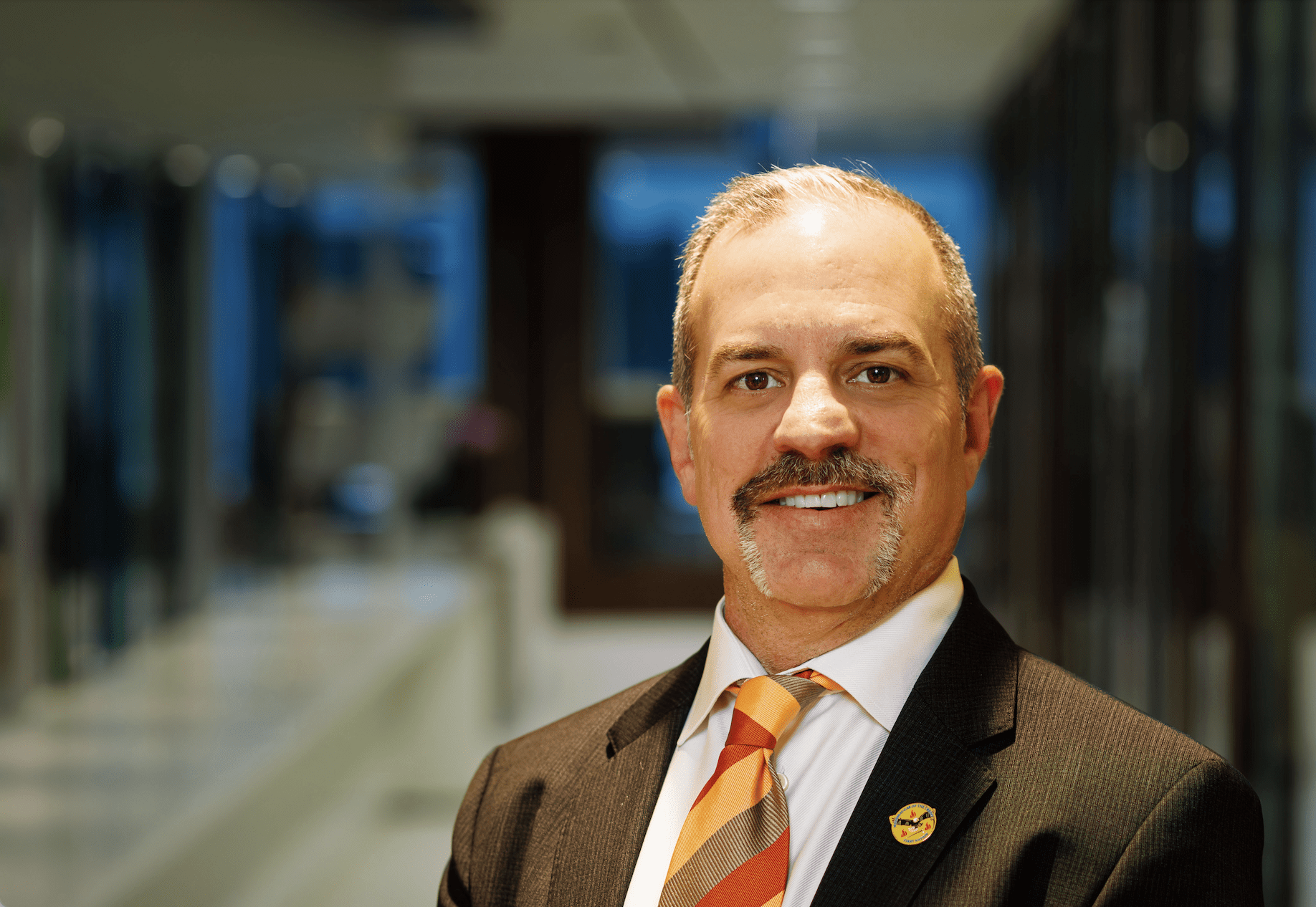
Jason Sparaga (BBA 1993) is the Co-Founder and Managing Operating Partner of Red Jar Energy Partners, a developer of bespoke power, energy, and other infrastructure assets. With more than 25 years of experience as an executive, owner, investor, and advisor, Jason brings deep expertise in opportunity sourcing, transaction structuring, and strategic growth.
He began his career in investment banking, founding Spara Capital Partners and facilitating over 100 successful transactions valued at more than $1 billion. In 2009, Jason co-founded Spark Power Corp., where, as Co-CEO, he led the company through 13 acquisitions, scaling it to $275 million in revenue and more than 1,400 employees. After building a strong management team, Jason stepped back into a board position where he continued to lead the corporate and acquisition strategy and stayed closely involved through the company’s successful sale in 2023.
At Red Jar, Jason leads a seasoned team focused on developing innovative infrastructure projects that respond to the evolving needs of communities and industry. Red Jar is defined by its entrepreneurial mindset, one that challenges convention and seeks new ways to unlock value within the power sector, while driving local economic and community development.
Jason holds a CPA designation and an Honours BBA from Brock University. He remains actively engaged with his Alma Mater as a Founding Member of the Goodman School of Business Executive Advisory Council and a member of Beta Gamma Sigma, the international business honour society. Jason’s accomplishments have been recognized by the AACSB, earning the Business Achievement Award and induction into the 2025 Class of Influential Leaders. His achievements in business have been recognized with multiple industry accolades, including the Canadian Business Excellence Award and selection as a finalist for EY Entrepreneur of the Year in the Power, Utilities & Environment category. Jason also serves as an OG100 (Ontario Global 100) Board Member.
A strong advocate for community impact and charitable giving, Jason is deeply committed to supporting the autism community and youth at risk through organizations such as Unity for Autism, where he serves as President of the Board and as a Board Member of 13th Round Fight for Life.
Q: What led you to choose Brock and the Goodman School of Business?
I’m a Niagara person. I grew up in Niagara Falls.
Coming out of high school, all my closest friends were going to Western, Queens, or the University of Toronto. I applied to those and got into all three.
I was a science stream guy, thinking I’d become a dentist or a doctor.
My whole family background was business, small business mostly, and somewhere in there, I knew that’s where I belonged.
I did my first year at Western, and started my second year in the math stream.
I didn’t like it. It didn’t fit who I was.
In the summer between my first and second year, I started a business selling flowers to people on street corners, in bars, wherever I could. It was very successful. I actually made enough money in that one summer to pay for my entire university education.
So I dropped out of Western, travelled, and the following year started at Brock because it was local, I could live at home, and I had this little business going.
What I really liked about Brock, compared to Western, was how different it felt.
Western was big, cold, and untouchable. I remember walking through campus on my first day and seeing 18 and 19-year-olds pulling up in Mercedes and BMWs.
The frat culture and the elitism felt deeply uncomfortable for me. I was from Niagara Falls, from a low-income area near the border; it was just a difficult place to navigate.
Brock felt like an oversized high school. You could talk to professors and administrators. It was warm and inviting. I thrived there.
Q: Are there any moments from your time at Brock that stand out as formative experiences?
Probably my conversations with Professor David Brown.
He really helped guide me through the transition from a science background into business, and then from business into getting my Chartered Accountant qualification (CA). He helped me lay out a path and actually paint a picture of how I was going to get there.
Running the flower business for a few summers while I was studying was formative in a different way.
There was a government program at the time, a youth entrepreneurial loan program through the banks, where you could apply for a grant or a low-interest loan.
With what I was learning in my business courses, I started to get my legs underneath me. Beyond just being creatively entrepreneurial, I started to understand the accounting and finance side of things, too.
That combination, the instinct to sell and the structure to manage it, really whet my appetite for being my own boss.
Once you have that feeling, you can’t go back.
Q: Are there any moments in your career where you felt underestimated? How did you become undeniable?
I was actually the one who started the conversation around the ‘underdog’ with the Goodman Legacy Council.
That was always my thing. I’ve delivered a convocation speech at Brock, where the whole address was built around it.
I constantly felt underestimated.
So it became a chip on my shoulder, almost like, all right, you won’t see me coming, and I’ll surprise everybody.
You really had to prove yourself worthy, coming from where I came from. I grew up in a town in Niagara called Silvertown. If you’ve ever driven through that neighbourhood, you know what it is.
Drug addiction, poverty, bikers – it’s a bad neighbourhood.
My parents had a convenience store with a soup-and-sandwich counter. My dad was one of those guys who just wanted to help people, so he turned it into something of a soup kitchen. Picnic tables in the backyard, feeding whoever came.
That shaped me, this sense of do good and do well, both at once.
That background followed me into my career. After getting my CA, I decided I wanted to be a dealmaker, a mergers and acquisitions advisor, and a corporate finance advisor.
I started interviewing for investment banking jobs in Toronto, but I didn’t have the pedigree. People were looking for credentials, history, or relationships, and everybody else was family with an investment banker or went to Western Ivy.
I was just a chartered accountant from the wrong side of the tracks in Niagara Falls. But I know how to make deals because I know how to sell stuff, speak to people, have empathy, and relate. This was my competitive advantage.
So I said, screw it, I’ll do my own thing. I started Spara Capital, named after the first part of my last name, positioning it as a boutique advisory firm for shareholders who felt like they weren’t being respected or taken seriously.
Defending people the way I’d always had to defend myself.
We built a reputation as a scrappy, tenacious group that would fight hard to get you the deal you deserved. That was the brand. A big part of it was the Brock underdog mentality: pushing through, proving yourself, and not waiting for anyone’s permission.
Q: What milestones or achievements best represent your career journey or impact since graduating?
I’m more of a journey person than a milestones person.
I think in terms of building, selling, buying, merging, doing the deal and then moving to the next thing.
I’ve built four or five businesses that I have sold. There was Spark, which we built from four of us to 1,400 employees over about 14 years, acquiring 13 companies along the way and taking it public.
We also built a Bitcoin mine from scratch and sold it, co-founded a marijuana business that went public, and launched a Bitcoin lending business.
Honestly, I always find milestones a bit anticlimactic.
You work really hard to get somewhere, and then when you arrive, it’s like I thought that was going to feel bigger.
The excitement is in the journey – in the getting there. The destination is just the starting line for the next thing.
Though if I had to pick one moment, it would be being invited to deliver the convocation speech at the Goodman School of Business.
It was around 10 years ago, not long after it was named Goodman.
My oldest daughter was graduating from Brock that same day, in a different faculty, a different part of campus.
I remember standing there, delivering the address to the business school. It wasn’t an award or a plaque; it was just that full-circle feeling of: I started here as a kid from Niagara Falls who didn’t fit anywhere, and now I’m the one speaking.
Q: How do you hope your story inspires the next generation of Brock and Goodman graduates?
What I hope people take from this is that you can go from irrelevance to somewhere meaningful, and you can do it with integrity.
It doesn’t have to be a means-to-an-end story where you step on people to get there. You can do well and do good at the same time.
I grew up watching my dad do exactly that with a soup kitchen out of a corner store, and I’ve tried to carry that forward in how I build businesses and how I treat people.
Be fearless. Don’t be afraid of failing. Fail as fast as possible. Try things, break them, start again. That’s always been how we operate.
I’d say, figure out where you want to get, set your sights on it, and don’t let anybody tell you you can’t get there.
Think about it this way, why not you? What’s the difference between you and anybody else?
But if you can see early, it’s not heading there, pivot today.
Especially when you’re young – your adaptability is a superpower, not a weakness.
I went to 12 different schools before I graduated high school. Between Grade Eight and Grade Twelve, my family lived in five different houses. My parents became real estate agents at forty and started over.
All of that made me adaptable, and I wouldn’t trade it.
Q: What motivated you to get involved with the Goodman Legacy Council?
There’s a complete void right now. No endowment fund, no legacy council, and very light alumni engagement, the kind of surface-level stuff where you get an email asking if you want to give $20 a month.
That’s not going to cut it anymore. There’s heavy lifting that needs to be done, and I’m a heavy-lifting kind of person. I don’t really enjoy putting my name on something I’m not actually participating in.
I also think there’s a genuine need for a school like Brock, one that positions itself differently from Western or Queens, where people from all walks of life feel like there’s a real pathway for them.
I’ll be honest: I don’t know exactly where Ontario’s educational institutions are going to be in ten years, given everything happening with AI, funding, and shifting careers. I think it’s going to be a real grind for Brock, but that’s exactly why this matters.
The most successful institutions in the world are supported by the people who came through them. Brock’s never really had that.
The alumni who’ve done well haven’t come back in a meaningful, organized way. This council is trying to change that. That’s why I’m here.




Stay Connected
Brock University
St. Catharine’s Campus
1812 Sir Isaac Brock Way
St. Catharine’s, ON
L2S 3A1, Canada
Privacy
| Terms & Conditions
Copyright © 2026 Goodman Legacy